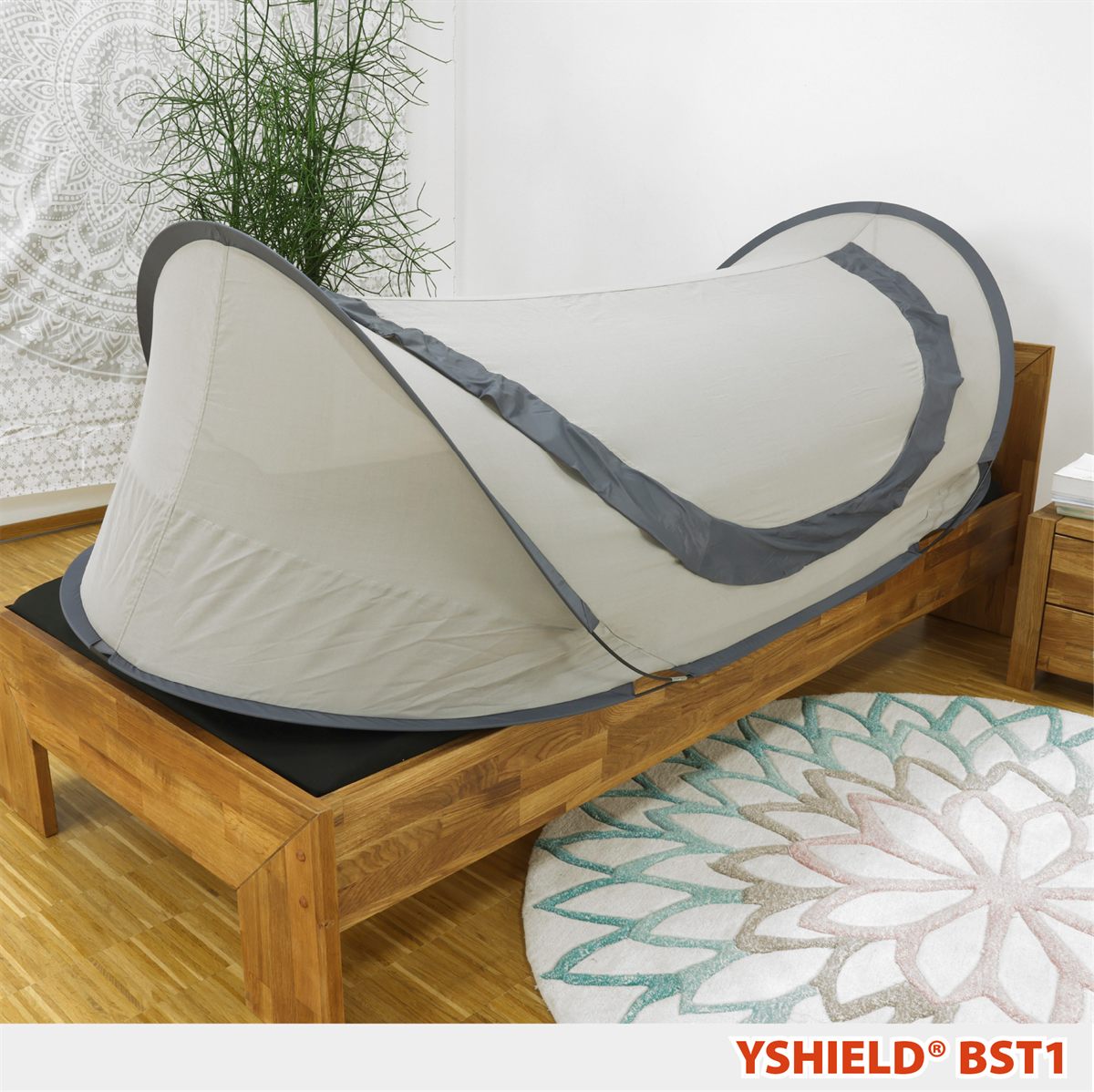
SAFECAVE BST1 Pop-Up Sleeping Tent
HF+LFPortable
Pop-up shielding tent that sets up in seconds; portable protection when travelling or staying away from home.
- Attenuation: 44 dB
- Size: 95 × 210 × 55 cm
- Setup: Pop-up, no hanging

The same physics since 1836: a conductive envelope separates its interior from external fields — the critical question is 'how big are the holes'.
Michael Faraday's 1836 experiment demonstrated a simple truth: an electric field applied to a conductive shell does not penetrate its interior volume; the charges redistribute on the outer surface. A similar mechanism works for time-varying fields: the incoming wave induces currents in the conductive surface that suppress its own effect, and it is largely reflected or absorbed.
In practice, do not let the word 'cage' mislead you: the envelope can be a mesh or a woven fabric as much as a solid sheet. The critical parameter is the ratio of the openings to the target wavelength.
An opening behaves well if it is roughly smaller than a twentieth of the wavelength: for 2.4 GHz (12.5 cm wavelength), a net with millimetre-scale pores is an effective envelope — that is the physics of shielding canopies. As frequency rises (5G mmWave), tighter weaves are needed for the same performance.
What decides the success of real systems is less the holes than the 'slots': an untaped joint, an ungasketed cover, a cable piercing the envelope. A long, thin slot can turn its area into an antenna. That is why in professional installation seams are bridged with conductive tape and penetrations are filtered.
At small box scale, yes — the foil layers must overlap and be complete. At room scale, DIY attempts usually fail on slot and penetration errors, and without measurement they offer no confidence.
If the envelope is incomplete (a hole, a slot, a cable penetration) or the material is inadequate at that frequency, signal leaks through. The difference between 'weak signal' and 'no signal at all' is large in dB terms.
Not for reflecting high frequencies; it is required for shielding low-frequency electric fields and for safety. That is why our products are classed as 'HF' and 'HF+LF'.
Pop-up shielding tent that sets up in seconds; portable protection when travelling or staying away from home.
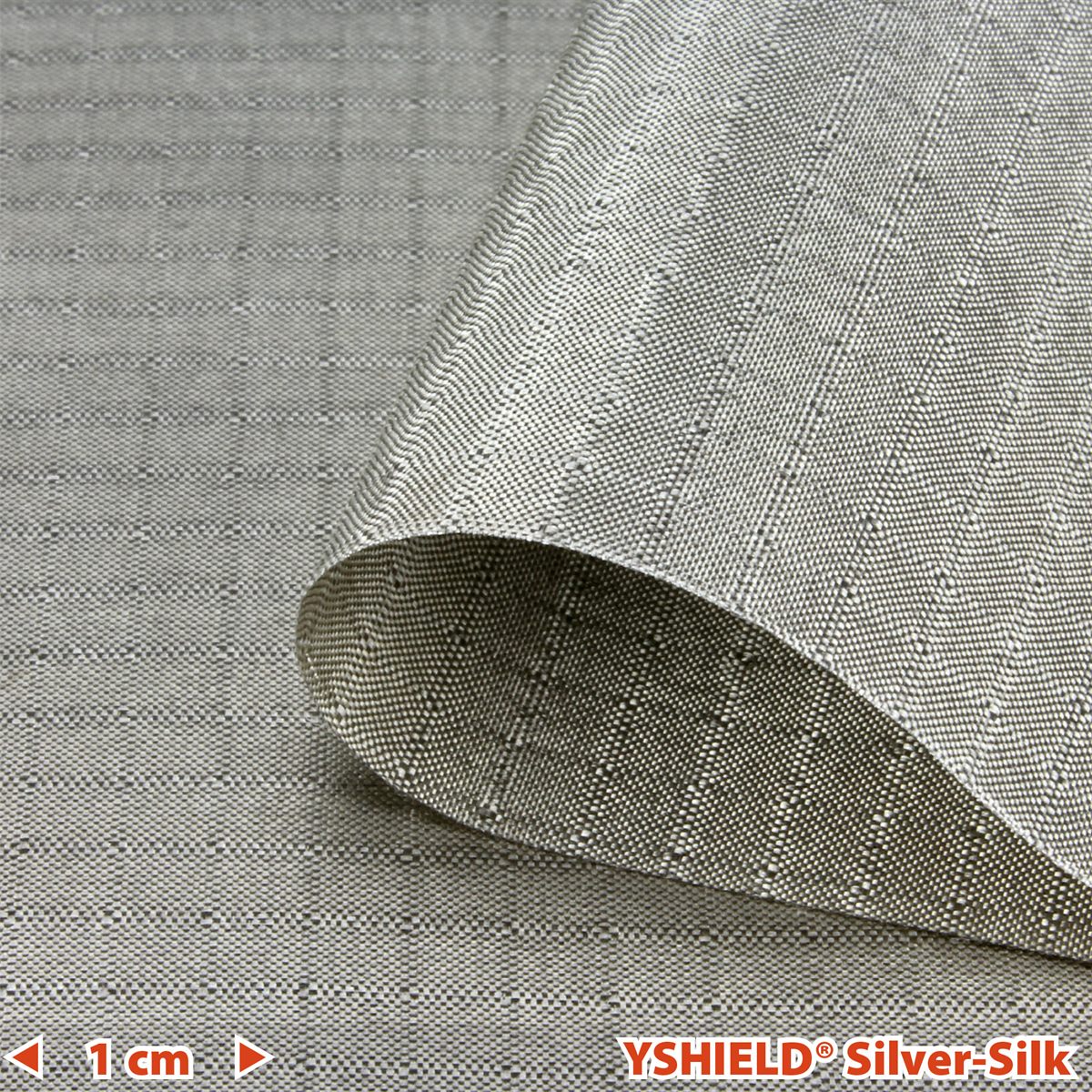
Silver-plated nylon technical fabric; high performance in technical applications such as phone pouches, cable shielding and device bags.
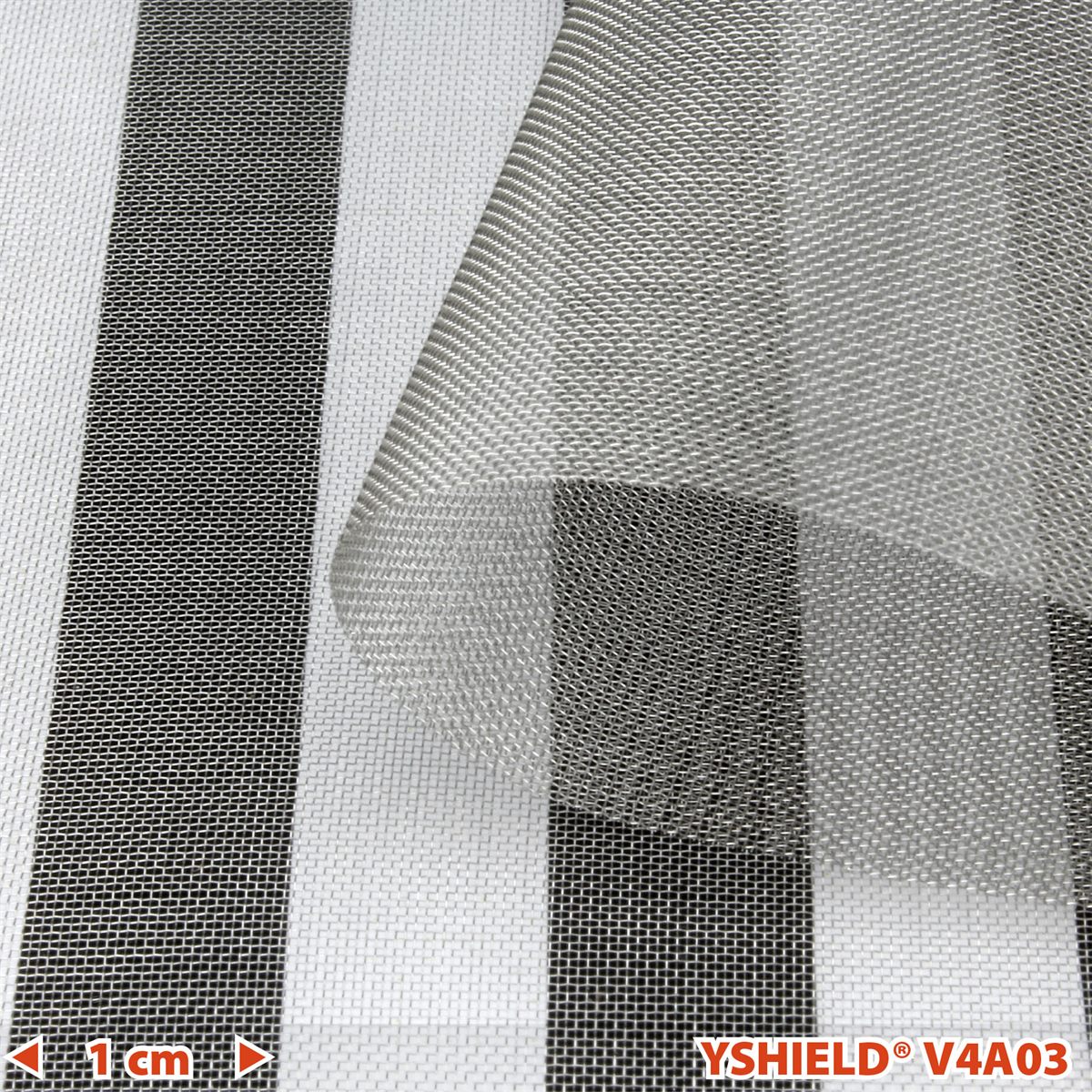
Fine-mesh V4A stainless weave; the highest attenuation in the line. Also used as insect screening — it protects at the window without blocking ventilation.
Talk to our technical team about quantity calculations, product combinations and application details — the site survey is free of charge.